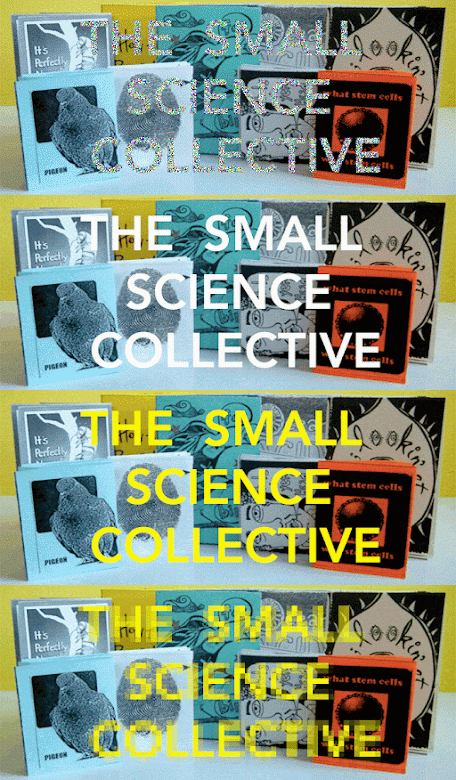
A collaboration of scientists, artists, students, and anyone else interested in science, this project produces small zines and web comics on a variety of topics . Read online, download zines, and share your ideas here!

Thursday, February 17, 2011

Fruit Flies - the workhorses of science

 _____
And what have we here?   The most noble of small insects, the fruit fly Drosophila melanogaster

Sure, there are over 4, 500 species of "fruit fly," but this one in particular has arguably contributed to our understanding of genetics more than any other critter yet.  How you may ask?  Well, well, this new zine called simply Fruit Flies & Science by Emily Fundis is the best short introduction I've ever come across. you could even say it is creating a "buzz."  If give an overview of the What and Why of this common and tiny fly and its role in over 100 years of science.
Because Evolution by Common Descent unifies all of life (thanks for pointing this out, Charles Darwin), studying the genetics of an insect of even a plant or yeast can in fact reveal much about the biology of creatures like ourselves. You have to respect these model organisms of biological research.  

 Now, you may say the after watching the movie "The Fly" you understand the whole matter, but I urge you to look a little deeper past such science-fiction. Plus that is NOT a fruit fly, but rather the common house fly Musca domestica. Isabella Rossellini gives some fascinating insight into those flies here.

For an additional general overview of fruit flies in biology, check out  this nice visual explanation, or explore some of the more famous mutants flies that are used in genetics.  For the  real detailed nitty-gritty that professionals get into, check out Flybase.

To read the zine online in comic format, click the image here:


And click here is the downloadable, printable, and foldable PDF version...


Remember what they say:   "Time flies like an arrow, fruit flies like a banana!"


_____

Sunday, February 13, 2011

from dry desert to coral reef...


Today we'd like to show highlights from a truckload of excellent zine submissions we received from Dara Nix-Stevenson's biology class at the American Hebrew Academy in Greensboro, North Carolina. 

The assignment?

Pick 1 land biome and 1 aquatic biome and create a zine to communicate the key characteristics of their selected biome.

Given all the zines and all the great content, we decided to simply highlight some of the  panels from zines covering a wide range of the environments their explored...

                                                         
 Deserts as discussed by Matthew Richman ~


Conifer Forests by Benjamin Rapp ~


 Tundra as discussed by Aviva Zucker ~


Coral Reefs by Inga Mamut ~


Hannah Ripps ~


And this is just a small selection, and we are only sorry not being able to include more here.... These zines were informationally rich and visually a pleasure -  an amazing set of zines, and The Small Science Collective wants to thank you all for sharing them with us.


Let's have a flying squirrel (from Rachel Senehenkova's zine) lead us out...!

Saturday, December 18, 2010

Eating Insects?


In a world whose burgeoning population and ravenous appetite for meat only continues to grow, sustainability is finding itself stretched to new limits.  The environmental, food safety, and ethical issues of raising cows, pigs, and fowl on such an extensive scale are myriad.  Take the example of beef and consider that pound-for-pound:

It takes ~200 times the amount of water to produce than potatoesIi takes about 5 pounds of grain for every pound of beef a cow produces
Feeding livestock consumes about 40% of the world's grain *

in overview....

Given this, what other options might there be for animal protein?  Perhaps one of the most common ones there is? That's right - insects!    Here are some very impressive nutritional statistics and recipes from National Geographic.   In fact Time magazine has a a data-rich article on topic, while David Gracer, from Small Stock, also males a nice case for bug brunching here on the Colbert Report a little while back.  The recent Insects Are Food website is also a good resource.


However, all that said, if you want a really nice and compact reference, I can suggest nothing better than than this new zine in the collective simply called "Entomophagy" by Moinca Ramirez. If gives a nice overview on these issues in a very handy format. Click on the image here to read it in comic form:


And of course feel free to download the printable and foldable version HERE to make your own hardcopy.


By the way, if you are interested in specific insects to dine on, consider cicadas!  Here is a zine about them in particular (recipe included) as well as an article.


And some more of this topic from our sister site, the Insect World as well as your editor here at Small Science partaking of some giant water bug found in the local grocery store...

Tuesday, November 30, 2010

The Theory of Sexual Selection

 ---

Why the differences between males and females of so many species - be they large horns, flashy feathers, strange songs, or bizarrely long "stalks" in the case of the stalk-eyed flies pictured above?   This question puzzled Charles Darwin even after he came up with his explanation for the diversity of life forms generally - evolution by natural selection.

Many consider Chuck D's solution to this conundrum of male and female traits as equally elegant: sexual selection theory.

(Feeling rusty on the concept? This video from the PBS Evolution series gives a summary of the basics.)

Denny Liu  has designed an attractive zine The Theory of Sexual Selection that gives us a clever and contemporary overview of the many ways evolution has crafted traits, from the notion of "good genes" to nuptial gifts.

To read this zine it as a web comic, click the image below and get a little knowledge ~


(unfortunately, as a 11'' x 17" inch zine it won't work for many home printers but be in touch if you want the PDF.) 

Another zine featured here at SSC also looks at sexual selection theory, check it out  here!

More to come on this topic, so keep an eye out ~

 -----

Wednesday, November 24, 2010

Free Water vs. Bottle Water

 -------  
Water is so apparently abundant, and yet increasingly precious - for drinking, agriculture, and industry.  Even Hollywood has become sensitized to the issue of fresh water access, be it the latest James Bond film or Matt Damon's new water advocacy organization.    

The bottled water phenomenon in North America is a puzzling one indeed. Some say it is healthier, others more convenient, and yet all of this is ironic given that we put millions of dollars into creating a public water system that is one of the best in the world. Lucky to be some of the people in the world that actually has access cheap and plentiful tap water, we in the US have opted in the last few years for the apparent chic of water plastique, bottled up and sold to us. 
Many have pointed out the virtues of tap water, and indeed that many bottled waters are in fact sourced from municipal taps to begin with!   Videos like The Story of Bottled Water gives us some insight into the marketing and social psychology behind it, as well as the environmental consequences of all that plastic...

But if you want to get the word out on the street, nothing better of course than a zine. Michelle Doh's zine, Fresh Water vs. Bottled Water gives a wonderful overview of the issue, including drinking tips!

Click on the image below to read the zine in comic form:


 And/or click HERE to download the PDF as a foldable zine (standard letter size).


Just how precious is fresh water? Sometimes you only realize it till its gone, as the Aral Sea story illustrates...
 ------- 

Saturday, September 4, 2010

* that crazy-brilliant Tycho Brahe

____
Many are fond of Copernicus (and his"revolution"), of Kepler and his astronomical ways - even Ptolemy gets a lot of credit for being simply wrong about the relationship of movement between the earth and the sun. But what about Tycho Brahe?

Tycho did remarkably detailed observations, tried his best to resolve issues between Ptolemic and Copernican views of the universe, and above all else made a lovely discovery: a supernova in 1572 that fundamentally changed the way people thought about the physics of the heavens and its changeablity.

Artist Sara Drake has done a wonderful job in the name of scientific biography in her about Brahe. Her zine brings us through the large life of a man devoted to making sense of the puzzling heavens (as well as partying and dueling to the point fo having his nose slashed off - oops, spoiler alert!). But there are plenty more bizarre details to ponder in the zine, so enjoy!


To read the zine, click the image below:

______
Click HERE to download the printable/foldable PDF version.
-----

Friday, August 27, 2010

Acid Advice

This last year's Zine-a-Thon generated a startling array of zines of various topics, and one that all of the judges loved was simply called "Acids" by Rishabh Tripathi, a high school student in
Nagpur, India.

Far less exotic perhaps than lattice QCD or dodos, Rishabh's zine conveys just how strange, common (we ourselves are composed on many different kinds of acids), and even dangerous certain acids can be. As the zines summarizes by way introduction:

"Horrible Details: Acids taste horrible and sometimes stink. You wouldn't want to go near some of them. They are strong enough to dissolve the human body!"

This only attests to the diversity of acids and the roles they can play, from flavoring your salad dressing to causing acid rain in the clouds.

To read Rishabh's zine, click the image below:


_______

And to download a PDF format of the zine in foldable form click HERE.

_______

Thursday, August 5, 2010

! The Indomitable Water Bear !

------
Chicago artist Alex Chitty has made a lovely, funny, and narratively nice contribution to our understanding of biodiversity through her zine Simplify Your Life (aka The Indomitable Water Bear).

Before you even ask what exactly the definition of "indomitable" is, you might also be pondering the following simple question:

Water Bear ??


Well, the water bear is like a lot other mysterious (and perhaps somewhat confusing ) common nomenclature mash-ups for organisms. Take for example: sea lions, monkey flowers, dolphin fish, or potato bugs - likewise, the water bear falls in the category of not exactly what it might sound like. It is not a bear, but a creature maybe vaguely shaped like one that happen to - when lucky - live in the water. Although to be fair the scientific name for these tiny invertebrates - Tardigrades - is no less cryptic. (They are quite cute was they dance through liquid space)

Alex presents us with the opportunity of what it might be like to be a wholly different kind of creature and what (from our ever busy, fragile, and pre-occupied human perspective) living the life of something like tardigrade might feel like.

These are bizarre and tough critters - read all about them:

Click the image below to read it in comic form....


And click HERE to download the PDF as a foldable zine (standard letter size).

oh, and:

Some more wonderful drawing of water bears.

------

------

Wednesday, June 23, 2010

Hmm....

____

Exploring the small science initiatives around the country, one nice example is Hmm... a small magazine out of Colorado that covers how science is done by researchers in the field. Though advertised as for middle-schoolers, this zine will be of interest to any one of any one with an inquiring mind towards the latest work being done in geology and weather.

Handsomely designed, it is no surprise the makers are graphic designers as well as science-minded writers. Go to this site to download the full edition!

Tuesday, June 22, 2010

Perfect! ~ the Circular History of Planetary Orbits

It was once believed that the heavens were a realm of complete perfection. For this reason, certain shapes like circles were thought to be to rule form and movement.

It is a fascinating history involving our human conceptions, perceptions, and in the end the successes of scientific reasoning that led us to understand the circle in fact is not the King of Celestial Shapes. What are the other shapes and how did we find them out?

To learn about this planetary topic, we suggest checking out a zine by artist and SAIC student Amy Schleser called Perfect! You can read it in comic form by clicking the image here:


- - AND.... If you want to download the printable and foldable PDF version, click here!

Wonderful zine contribution and winner of the "Astronomy" category of this past year's Zine-a-Thon contest - in a word: perfect!

-------
-------

Deep Dive: Exploring the Mussel Tussle

Mussels are a kind of bivalve. Like their cousins the oysters, clams, and scallops they live a shelled (although not completely sheltered) life in freshwater rivers & ponds to expansive oceans all across the globe, filtering water for tiny morsels worth eating.

Mussels of course can be worth eating themselves as a tasty meal, as all these recipes show. Then again, some mussels, like the Zebra mussel, have become difficult pests in areas like the Great Lakes, drastically changing ecosystems and causing economic hardship...

But what about the overall biological lives of freshwater mussels? What about the risk of extinctio for others? What factors are at play. To answer these questions we only need to read Lauren Hughes' zine Deep Dive: Into the Secret Live of Freshwater Mussels to get a rich visual guide to the topics, and others besides (click on the comic below to magnify):


- - If you want to download the printable and foldable PDF version, click here.

Wonderful zine contribution and winner of the "Oceans & Water" category of this past year's Zine-a-Thon contest!

_______
_______

Sunday, February 21, 2010

* Meeting a Giant Octopus *

-----
The Octopus is a creature of splendor and mystery, there is simply no doubt about it, and the Giant Octopus, even moreso.

These cephalopods change color, pattern, and can navigate mazes. In fact , they are so dynamic and clever it has recently been shown they are the only invertebrates known to use tools !

In the images here we see one diver apparently hugging a giant octopus; in the other Captain Nemo watches one at a casual distance in an illustrations from Jules Verne's 20,000 Leagues Under the Sea.

But just what would it be like to meet one?

Thankfully, there is a zine that helps us with just this question: Chen Dou's zine "Meeting a Giant Octopus," which won the Grand Prize in Year of Science 2009 Zine-a-thon co-organized by the SSC and COPUS, explores just what it might be like to learn about the a giant octopus through a first hand meeting.

I recently asked Chen what she likes most about drawing animals:

"I've always felt as if drawing animals brings me closer to the creatures that share residence on planet Earth because it allows me to place myself in a different world where there is more interaction and understanding between human beings and other species. In our society today, it seems as if we are completely isolated from the natural world and rather indifferent toward the interaction and protection of other species. Wouldn't it be great if we got to know these mystical and beautiful creatures a little better?"

I think Chen's zine accomplishes just that sense of trying to get to know an animal, especially in the case of octopi and their remarkable intelligence...

Thanks so much for sharing this zine, Chen!

- - If you want to download the printable and foldable PDF version, click here.

You can also check out the zine here on the Year of Science site (click it to magnify)


ps:
Mind you, NOT to be confused with the "giant squid," or the "colossal squid" (nor confused with each other)

-----
-----